Alternative Response
The goal of the City of Tacoma’s Alternative Response programming is to connect more people with the right services at the right time.
Alternative Response has three focus areas – homelessness outreach, behavioral health response, and unarmed community service officers – that coordinate the work of three City of Tacoma departments – Neighborhood and Community Services, Fire, and Police – under the guidance of the City Manager’s Office.
By complimenting the traditional and crucial public safety roles these departments play, we are attempting to meet every Tacoma community member with a services first approach. That is, when at all possible, to safely connect our neighbors with the shelter support, behavioral and mental health care, and non-emergency response they need.
Learn more about these efforts below.
Homeless Engagement and Alternatives Liaison (HEAL) Team
The Homeless Engagement and Alternatives Liaison (HEAL) Team helps unhoused residents with referrals to supportive services and shelters throughout Tacoma. Through this work, they gather information on the causes of homelessness and effective solutions, which in turn helps inform the City’s strategy. The HEAL Team also monitors the cleanup of encampments in collaboration with other City departments and contracted vendors.
The HEAL Team has been fully staffed since September 2023 with eight civilian outreach specialists who respond to requests for contact at encampment locations throughout Tacoma.
Learn more about the HEAL Team
Holistic Outreach Promoting Engagement (HOPE) Team
The Holistic Outreach Promoting Engagement (HOPE) Team at the Tacoma Fire Department provides holistic, person-centered, and recovery-oriented care to the community. Established in 2023, the HOPE Team supports community members experiencing or impacted by behavioral health, mental health, substance use, and co-occurring disorders. HOPE Team services are 911 dispatched and work in coordination with community providers, hospitals, jails, courts, and first responders.
Learn more about the HOPE Team
Community Service Officers (CSOs)
With the understanding that not every service call requires an armed officer, the Tacoma Police Department launched the unarmed Community Service Officer (CSO) program in 2024. CSOs respond to a wide range of non-violent, non-emergency, and low-risk calls. Centered around providing a holistic approach to community safety that decreases both priority and non-priority call response times and enhances the police department’s responsiveness to community needs, there are currently five CSOs working in the field to assist community members and build relationships in Tacoma’s diverse neighborhoods.
Goals & Data
One of the City of Tacoma’s four core values is Belief & Trust, and one aspect of this commitment to the public is a commitment to providing data on the programming we provide.
HEAL
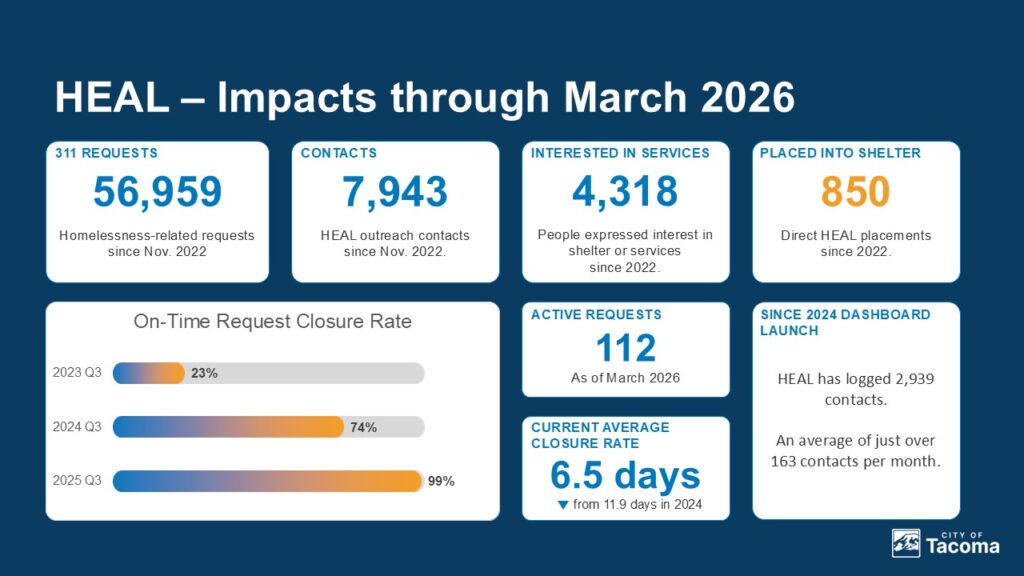
The Homeless Engagement Dashboard offers a unique opportunity to explore data on the outreach efforts of Tacoma’s HEAL Team. Users can filter data by geographic area, request type, date, and more to gain insight into individual engagements and understand the impact of our work.
The graphic below shows the impact of the HEAL Team as of May 2026.
HOPE
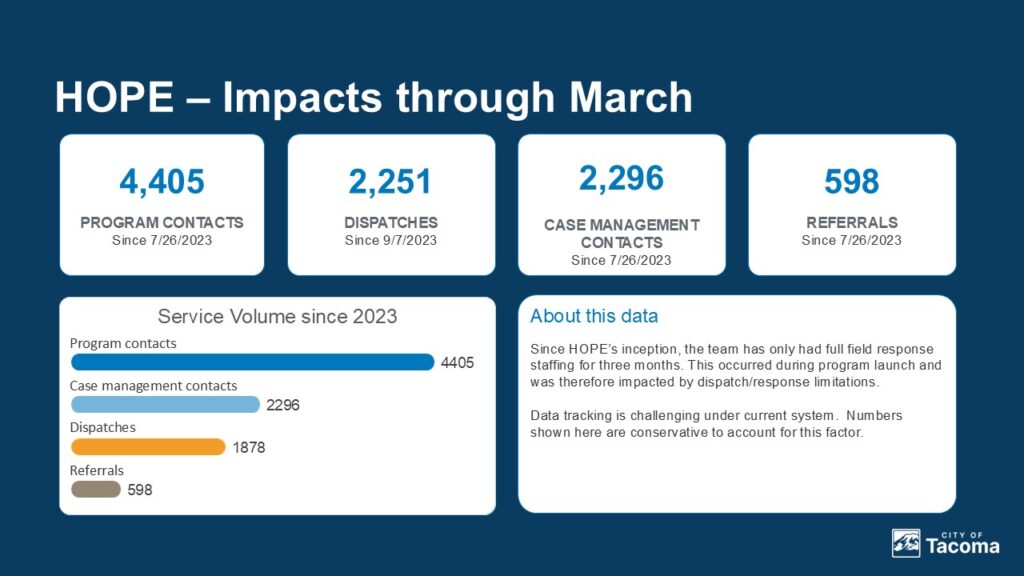
The graphic below shows the impact of the HOPE Team as of May 2026.
CSOs
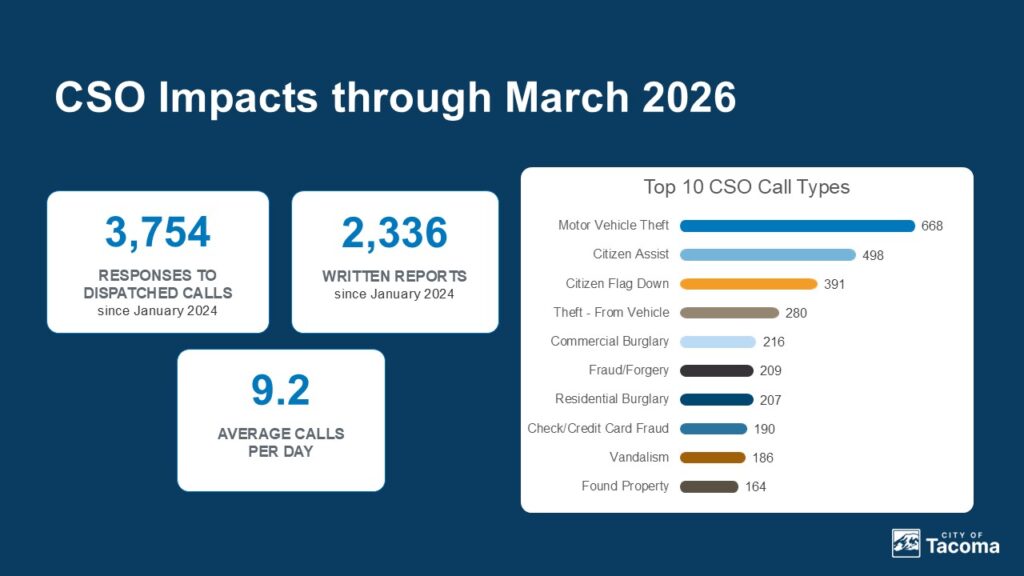
The Crime Dashboard is an interactive tool that allows users to filter and query selected crime types by various geographic areas such as City Council districts and police sectors as well as other data attributes.
The graphic below shows the impact of the CSO program as of May 2026.
Accountability and transparency is important to the work we do, and it’s at the core of Tacoma Open Data. We want you to continue to hold us accountable. We want you to continue engaging with us, even when we must have tough conversations. And we want you to continue informing the work that we do. With access to data from the City of Tacoma and its community partners through this tool, we’re hoping to make it a lot easier for you to do that.
Frequently Asked Questions
-
The most recent City Council presentation on Alternative Response was during the May 19, 2026, Study Session. You can view the presentation here.
-
Our three Alternative Response Programs—HEAL, HOPE, and CSOs—were established at the City Council’s direction and can be traced back to 2021 recommendations in the 21st Century Policing report and the Matrix Consulting Group report on alternatives to law enforcement responses. Feedback from the Council, community members, key stakeholders, and advocacy groups has consistently informed these efforts and how City Council and staff have worked to improve them.
-
The HEAL Team is staffed with eight civilian outreach specialists who respond to requests for contact with unhoused individuals at encampment locations throughout the City of Tacoma. The HEAL Team conducts its work cooperatively with law enforcement partners who are part of TPD’s Homeless Outreach Team, but it is key to note that HEAL does not have arrest authority and like all City of Tacoma staff, they take a services first approach.
The HEAL Team helps unhoused individuals with referrals to supportive services and shelters throughout Tacoma. Through this work, they gather information on the causes of homelessness and effective solutions, which in turn helps inform the City’s Homelessness Strategy. The HEAL Team also monitors cleanup of homeless encampments in collaboration with other City departments and contracted vendors.
-
The HOPE Team provides a specialized response to behavioral health calls that come through 911. HOPE Team services are specifically designed to effectively engage with people impacted by behavioral health, mental health, substance use, and co-occurring disorders. HOPE Team staff have more flexibility to stay on-scene and take additional time to engage with community members and assist them with stabilization—things like de-escalation, safety planning, risk assessment, connection to resources or treatment options, or in some cases, non-emergency transportation.
The HOPE Team responds to calls in a team of two—a registered nurse and a mental health professional, with a case manager working to connect and track services administratively. Additionally, the HOPE Team is available to provides support to traditional emergency response teams at Tacoma Fire and Tacoma Police.
-
Community Service Officers (CSOs) are unarmed TPD staff members who respond to calls for service that are incidents not in progress, routine in nature, or that pose no immediate threat. Some examples include assisting with traffic control, meeting community members to assist with filing crime reports, and providing resources to community members. CSOs do not have arrest authority beyond that granted by state law to any private resident and do not carry or possess a firearm while performing their official duties.
-
Yes. The Tacoma Public Library has a Patron Support program that balances traditional library functions with limited social service delivery. In January 2024, Tacoma Public Library added a staff social worker whom Library patrons can meet with to receive counsel and get connected to services in the community. Learn more about this program on the Tacoma Public Library website.
-
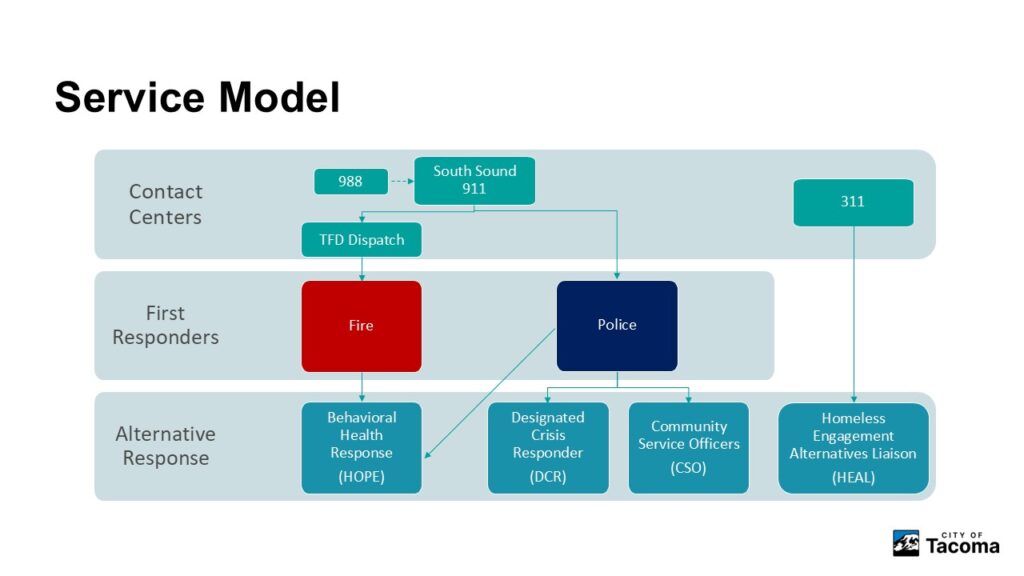
The HEAL Team is dispatched through Tacoma FIRST 311.
The HOPE Team and CSOs are dispatched through South Sound 911, the Tacoma Fire Department dispatch team, and the 988 Suicide & Crisis Lifeline.
The graphic below illustrates the dispatch service model for Alternative Response programs.
-
Always dial 911 for emergencies, including when a person appears to be an immediate danger to themselves or others, or if they appear seriously ill or disabled.
- Request HEAL Team Outreach through the dedicated Tacoma FIRST 311.
- If you or someone you know is experiencing a behavioral health crisis (a non-life-threatening but urgent behavioral health need), call the Regional Crisis line for in-person support at 1-800-576-7764. For support over the phone, text or call 988.
- Call (253) 287-4455 for the Tacoma Police non-emergency call center.
- Report a crime online at TPD’s Report a Crime web page.
- Call Tacoma FIRST 311 to report an unauthorized encampment, littering or illegal dumping, abandoned vehicles, or to request one of dozens of other City services. You can also file a 311 report or request for service online at Tacoma FIRST 311, or by downloading the Tacoma FIRST 311 app for Apple or Android.